CMU 10-799 Diffusion & Flow Matching
Spring 2026, Mini 3, Carnegie Mellon University | Tue & Thu 5:00 PM - 6:20 PM, SH 105
Instructor

Education Associate
Course Advisors

Teaching Assistants

Announcements
| Jan 18, 2026 | The recording of our first lecture is up on YouTube now! We shall hope to upload the recordings from the previous week every Sunday and Wednesday! Hope you guys will enjoy them! |
|---|---|
| Jan 18, 2026 | By popular demand, we will make Homework 1 Question 6 (Alternative Parameterization) an optional extra credit question! Office hours also officially start this week! Check out Schedule for more details! |
| Jan 15, 2026 | Homework 1 is out! The due date is 1/24 Sat 11:59 PM ET and the late due date is 1/26 Mon 11:59 PM ET. Checkout Homework for more details. |
| Jan 10, 2026 | Modal is generously sponsoring this class! Thank you Modal! They will give a tutorial on how to use their platform on 1/16 (a Friday special lecutre, 5 PM SH 105). Make sure to join then! |
| Jan 09, 2026 | At this point in time we have officially registered 64 students and sent 8 invitations for students who are overloaded. Check the discord announcement and your email for details! |
| Dec 28, 2025 | We got a much larger room (Scaife Hall 105) now :)! However, due to teaching staff and compute resource constraints, we still cannot officially admit everyone who’s on the waitlist :(, please refer to the FAQs for more details. |
| Nov 16, 2025 | Thanks to everyone who signed up or wants to join the class! We’re thrilled by your enthusiasm and a waitlist of 100+ students is truly something we never anticipated! We’re currently working on scaling up the class to accomodate more people. Please stay on the waitlist while we figure this out! |
| Oct 29, 2025 | Welcome to Spring 2026 10-799: Diffusion Models & Flow Matching (a.k.a Dungeons & Diffusion, because our classroom will be on the first floor of Posner :))! Check out the schedule and syllabus pages for more details about the class! |
Course Description
Want to understand how Stable Diffusion, DALL-E, and Sora actually work – and how to build something even better? This course takes you from mathematical foundations to hands-on research frontiers in diffusion models and flow matching, the generative AI frameworks reshaping computer vision and beyond.
In this class, you will explore topics from foundational probabilistic modeling through modern advances: denoising diffusion models, score-based SDEs, flow matching, fast sampling algorithms, controllable generation, flow maps & distillation methods, and discrete variants.
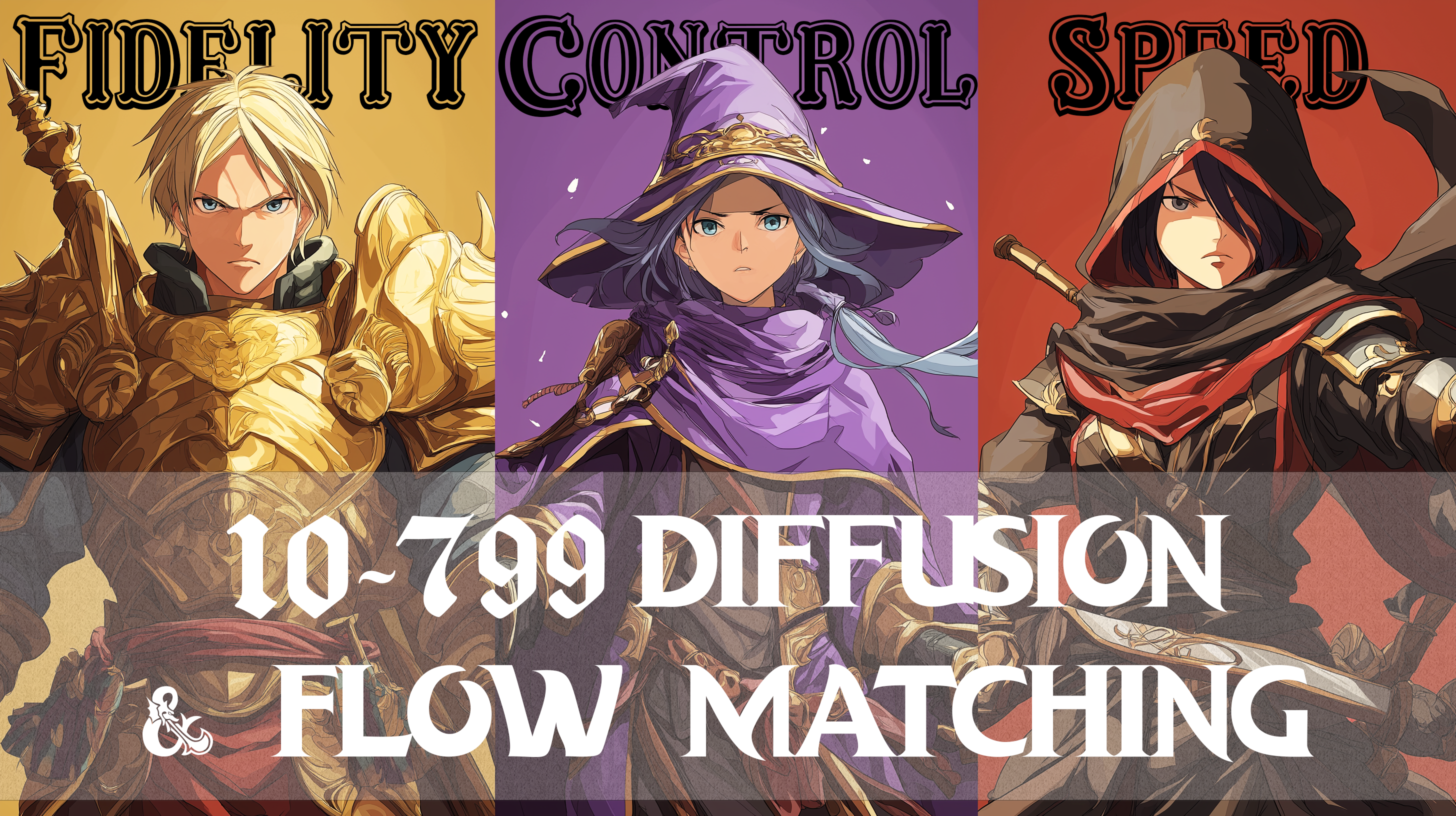
Choose your path to level up – fidelity (photorealistic quality), controllability (precise user control), or speed (real-time generation) – and build from scratch towards a complete working system through cumulative homework. You’ll strengthen both your theoretical understanding and practical implementation skills by the end of this course.
This class has no exams and is ChatGPT friendly! You are free to use resources like pre-trained models, open-sourced GitHub repositories and AGI-powered coding assistants for your assignments!
Course Information
Units: 6 units (half-semester course, Mini 3)
Time & Location: Tuesdays & Thursdays 5:00 PM - 6:20 PM, Scaife Hall (SH) 105
Course Duration: Jan 13th - Feb 27th, 2026
Communication Platforms:
- Discord: Course discussions and announcements
- Gradescope: Assignment submissions and grades
Target Audience: Anyone who wants to learn about diffusion/flow matching (as long as they have met the class prerequisites)! If you are an MLD PhD or master’s student, this class can also be counted as a 6-credit elective!
Prerequisites
It’ll be helpful if you’ve taken the following CMU courses or have a similar background — that way, you’ll be ready to dive right in! (P.S. You don’t have to have taken exactly these courses, as long as you have the relevant knowledge you should be fine. :))
- 15112 - Fundamentals of Programming and Computer Science
- 21259 - Calculus in Three Dimensions
- 21341 - Linear Algebra
- 21260 - Differential Equations
- Probability: One of 15359, 21325, 36219, 36217, 15259, 36218, or 36225
- Machine Learing: Python coding and at least one machine learning/deep learning course
Learning Objectives
By the end of this course, you should be able to:
- Understand the mathematical foundations of diffusion models and flow matching
- Implement core algorithms from scratch (denoising diffusion & flow matching)
- Build and train diffusion/flow matching based image generative models
- Apply fast sampling, controllable generation, and distillation techniques
- Conceptually extend these methods to discrete domains
- Present and communicate your technical implementations effectively
Sponsors
We are grateful to our sponsors for their generous compute support of this course.

